
Buffr HQ
A real venue, not a submission form. Buffr HQ runs the registration, team formation, submission pipeline, and judging for any hackathon, in a tiled virtual space where people actually see and talk to each other.
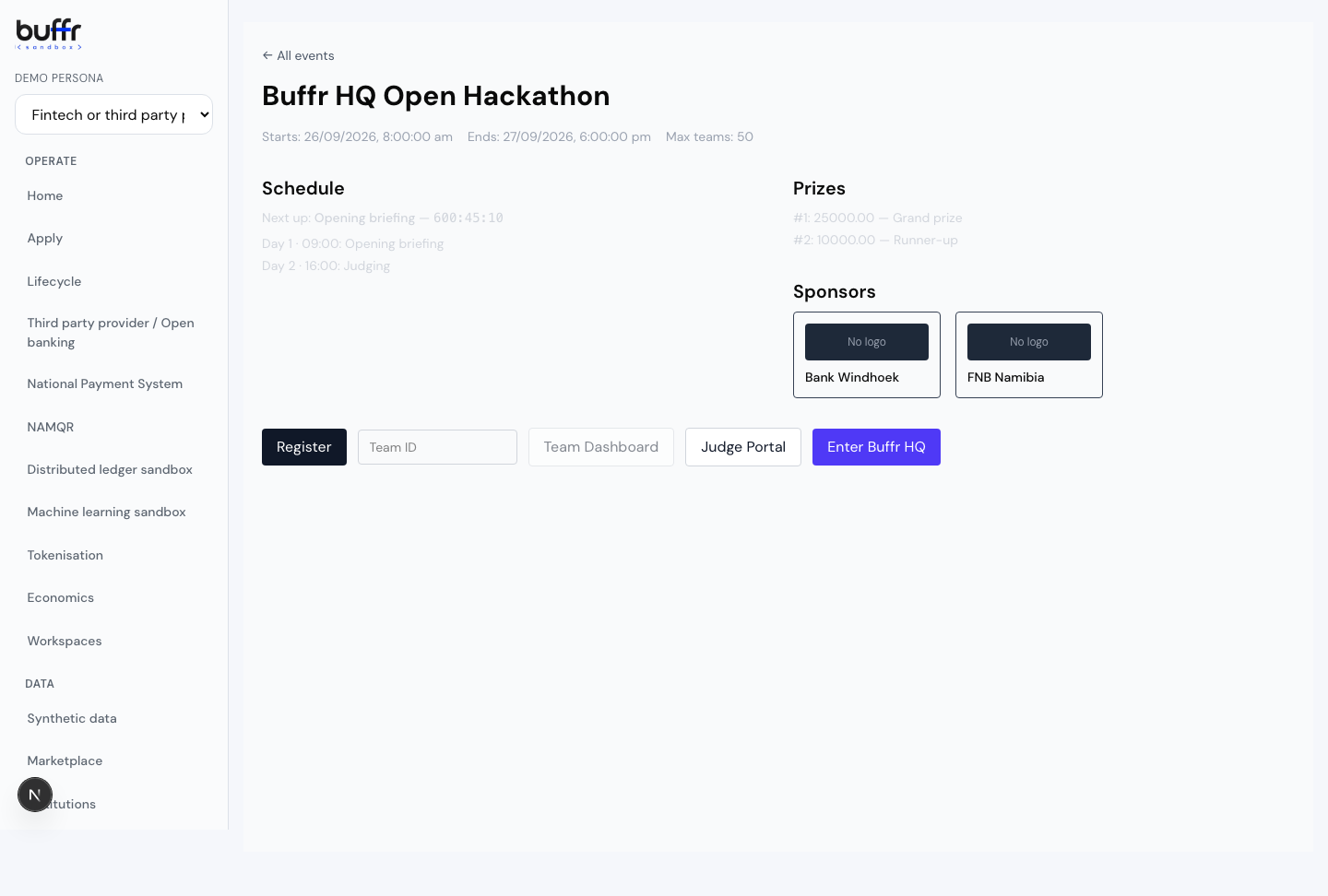
What Buffr HQ is
A hackathon platform: one product covering event setup, registration, team formation, submissions, and multi-round judging, plus a spatial venue underneath it. Buffr HQ is its own platform, not a feature of another product. Any host bank, fintech, vendor, or independent organiser can stand up an event and run it their own way. The host decides the theme, judging criteria, prize structure, and eligibility rules. Buffr HQ's job is the venue, the pipeline, and the judging workflow underneath it.
- Event setup with a host-defined theme, dates, and eligibility rules
- Registration, team formation, and join-requests
- A draft-validate-submit pipeline with resubmission
- Multi-round judging with a conflict-of-interest guard and anonymous scoring
- A tiled virtual venue with proximity video, voice, and text chat
- Coverage-grid badges tracked automatically as teams complete challenge objectives
A venue, not a form
Everyone shares one tiled map for the full duration of the event.
- Independence Avenue. The lobby. Registration, schedule boards, and the welcome desk.
- Etosha Pan. The common area for informal conversation, gallery walls, and cross-team demos.
- Dune 45. The stage for opening briefings, announcements, and closing pitches.
- Brandberg. The judges' chamber. Access gated to judges and organisers by scoped token.
- Welwitschia. The mentor office for booked office hours with mentors the host lines up.
- Trans-Kalahari. Sponsor booths.
- Team rooms. Private rooms with a whiteboard, locked to each team's own members.
Presence, not a leaderboard page
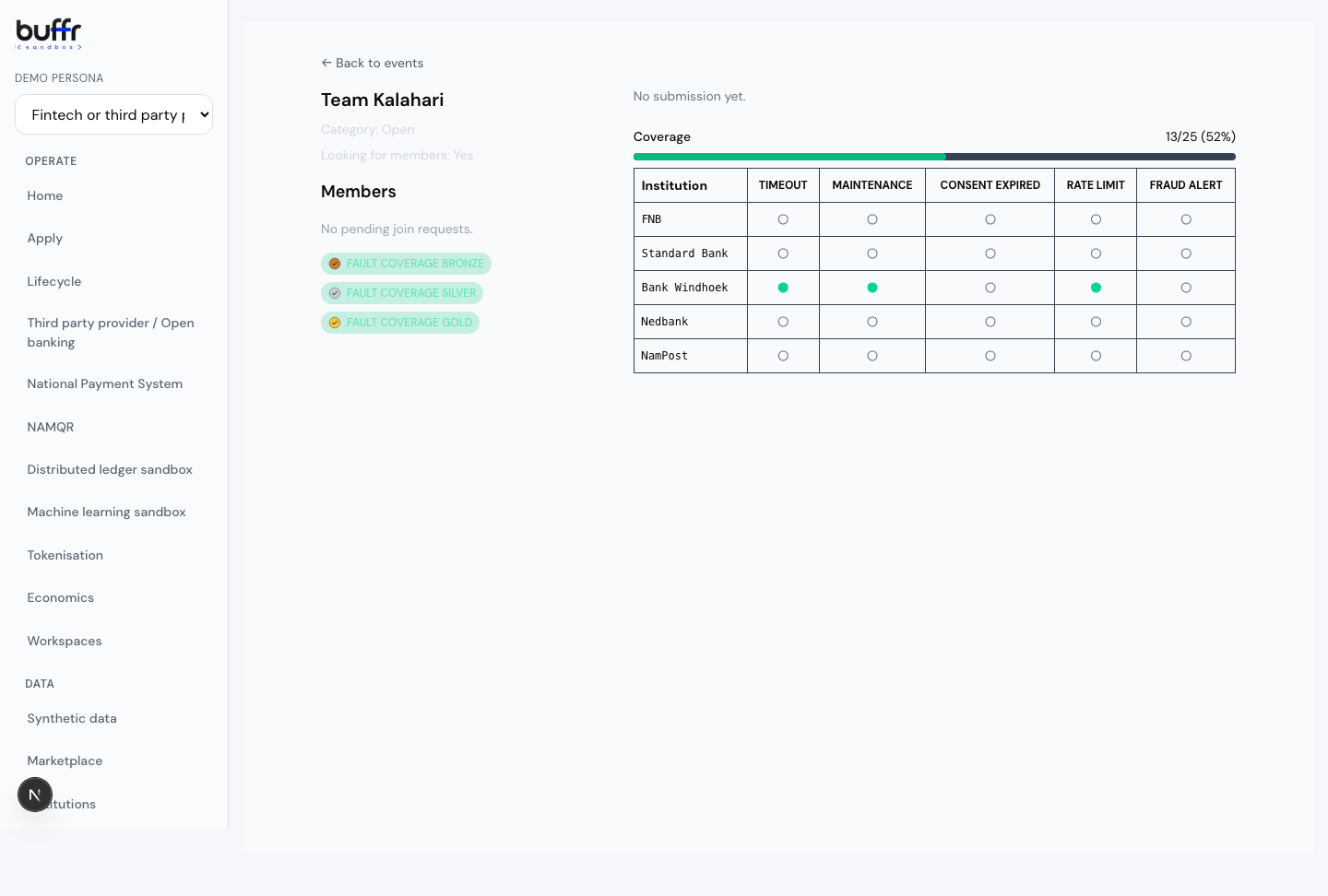
A real team dashboard, not a mockup.
Participants move an avatar between rooms and see who else is nearby, with proximity-based video and voice: walk up to someone and you're connected, walk away and you're not, the same way an in-person hallway conversation works. Interactive objects (schedule boards, megaphones, gallery walls, whiteboards, mentor desks, and sponsor booths) carry their own behaviour rather than sitting as static images.
Teams earn badges on a coverage grid as they complete the host's own challenge objectives, tracked automatically rather than awarded by hand. The screenshot on the right is a real team that earned bronze, silver, and gold coverage badges by exercising fault scenarios against three of the five reference institutions.
Judging, set by the host
Multi-round judging runs with a conflict-of-interest guard so a judge never scores a team they are affiliated with, and judges score anonymously against the host organisation's own published criteria. Prize structure, categories, and amounts are entirely the host's call: a single grand prize, a multi-category split, a community-choice track, whatever fits the event. Buffr HQ tracks outcomes and coverage badges so whichever categories a host chooses can be judged on real evidence.
Questions
Who can host an event on Buffr HQ?
Any host bank, fintech, vendor, or independent organiser. You set the theme, dates, judging criteria, prize structure, and eligibility rules. Buffr HQ doesn't dictate any of it.
Is Buffr HQ only for fintech hackathons?
No. Nothing about the platform requires a fintech theme. Host a payments hackathon, a climate hackathon, an internal company hack week, whatever your organisation wants to run.
How is this different from a Devpost-style form-and-leaderboard hackathon?
Devpost is a submission gallery: a form, a deadline, a judging dashboard. Buffr HQ adds a real venue underneath that pipeline, tiled rooms, avatar presence, proximity video and voice, and interactive objects, so an online hackathon feels like people showed up somewhere instead of just filing paperwork.
How is the venue different from Gather.town?
Same idea (a tiled space, avatars, proximity presence) built specifically around the hackathon lifecycle instead of a general-purpose office: registration and team formation, a submission pipeline, multi-round judging with a conflict-of-interest guard, and a coverage-grid gamification layer, all in one platform rather than bolted together from separate tools.
What does hosting actually involve?
Create an event, set your judging criteria and prize structure, open registration. Buffr HQ runs the team formation, submission pipeline, venue, and judging workflow for you.
What happens to a team's data after the event ends?
Submissions, scorecards, and outcomes stay in the event's own record. Buffr HQ doesn't share them with any other Buffr product unless a host explicitly flags a team as eligible for something else, which is a separate, deliberate action, never automatic.